
What Spotify’s hidden Popularity Score reveals about how independent music really gets discovered — and why the first few weeks decide everything.
I took a look at Spotify’s Popularity Scores recently, and what they reveal is worth sharing — not as a complaint, but as an honest look at how the discovery game actually works for an independent artist.
The hidden score behind every song
Spotify quietly gives every track and artist a hidden score from 0 to 100. Think of it as a credit score for your music. It isn’t lifetime streams. From what artists have pieced together over the years, it’s heavily recency-weighted — it rewards a burst of plays right after release far more than a slow trickle over time.
The rough consensus among independent musicians is that crossing into the 30s is roughly where Spotify’s algorithm starts working in your favour: feeding you into Discover Weekly and larger editorial and algorithmic playlists. None of this is officially published, so treat the exact numbers as informed estimates rather than gospel. But the underlying pattern — that early momentum matters enormously — is something almost every indie artist recognises.
Where JULIENCE sits today
Here’s a snapshot of the JULIENCE catalogue’s scores (June 2026):
- Love Lies Cold 25%
- Time Is A Weapon 25%
- Port to Port (The Lonesome Sailor) 22%
- The Road Less Travelled 20%
- Black Sheep 15%
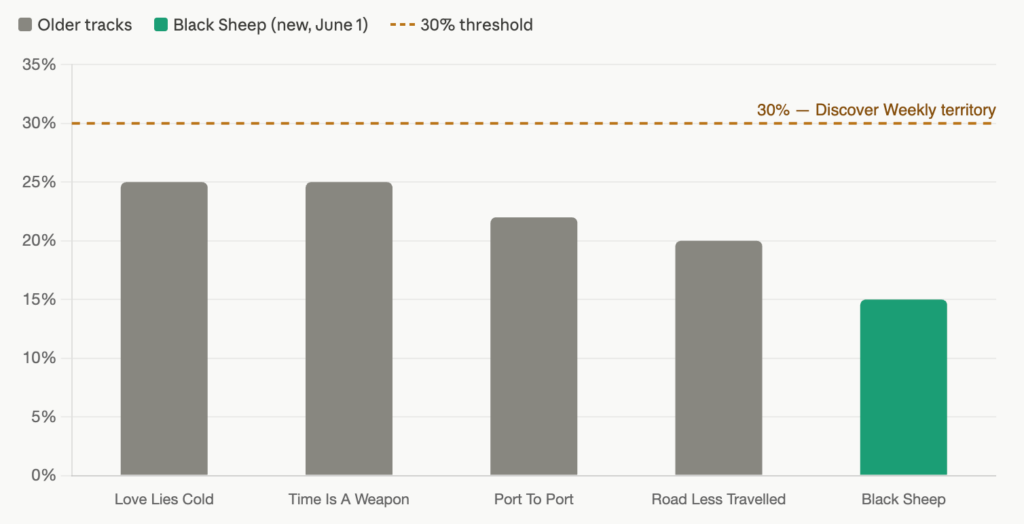 JULIENCE — Spotify popularity scores (June 2026). The dashed line marks the ~30% threshold where algorithmic discovery tends to kick in.
The pattern that repeats
Look at the top four — they’re all older songs. They’re sitting at a respectable 20–25% now, but they were nowhere near these numbers in the first few weeks after release, when it actually counts. By the time the algorithm noticed them, the early window had already closed. The scores look decent on paper today, but the momentum wasn’t there when Spotify’s system was deciding whether to push them.
That’s the quiet reality for most independent artists. The work doesn’t fail on quality — it fails on timing. A song can be genuinely good and still slip past the moment that would have carried it to new listeners.
Why the first weeks matter
The most recent release, Black Sheep, is a live example of this in motion. It came out on 1 June 2026 and currently sits at 15%. The weeks immediately after a release are the rare window where a single play genuinely moves the needle — where real listeners, not the algorithm’s mood, decide whether a song gets a fair shot.
That’s the whole point of writing this. These scores are public if you know where to look, and they tell a more honest story than the headline “streams” number ever does. Independent music lives or dies by real listeners showing up early — and that’s something anyone can be part of.
If you’ve ever wanted to actually help an independent artist break through, the most useful thing you can do is listen early and share what you love.
🎧 Listen to JULIENCE on Spotify
And I’d love to know: what’s your favourite JULIENCE track?
Tell me in the comments.