
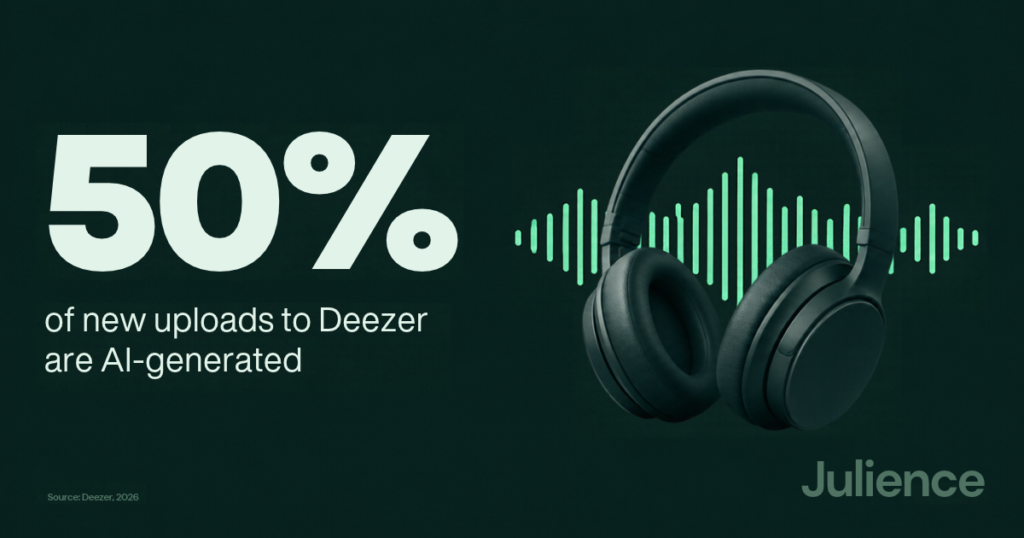
In January 2025, the streaming service Deezer reported that around 10,000 fully AI-generated tracks were arriving on its platform every day. By June 2026, that figure had reached around 90,000 a day. At peak levels, more than half of all the new music being uploaded to Deezer was AI-generated.
I write, play and record every Julience song myself, on guitar, bass, drums and keys. Each new single now goes into the same upload queue as tens of thousands of tracks a day that no person actually wrote or played.
The strange thing is that very little of this AI-generated music gets listened to. Deezer says fully AI-generated tracks account for only 1 to 3 per cent of streams on its service. It also found that up to 85 per cent of the streams on those tracks in 2025 were fraudulent: bots playing machine-made songs to collect royalties from the same pot that pays working musicians.
The big platforms have started to respond, each in its own way. Deezer tags fully AI-generated tracks so listeners can identify them and keeps them out of its algorithmic recommendations and editorial playlists. It has also announced a new filter, coming next month, that will allow listeners to exclude fully AI-generated music from search results.
Spotify has taken a slightly different approach. Since September 2026, it has been rolling out “AI Persona” badges for artist profiles whose public identity is AI-generated. These badges identify AI-generated artist identities, not necessarily AI-generated music. Spotify also keeps identified AI Personas out of its editorial and personalised recommendations unless you deliberately follow or engage with them. It has introduced separate AI Credits to give listeners more information about how AI was used to make individual tracks.
This follows the controversy around The Velvet Sundown, a band presented as human that attracted a large audience on Spotify before its AI-generated identity and music became public.
One finding from a Deezer survey has stayed with me. In a blind test conducted for its 2025 study, 97 per cent of people couldn’t reliably distinguish fully AI-generated music from music made by people. And 80 per cent said fully AI-generated music should be clearly labelled.
Deezer published a new survey today, and that 80 per cent figure remains. This time, the question included both fully AI-generated and AI-assisted music. The survey also found that 72 per cent of music streaming users want to know when their platform recommends fully AI-generated music.
 So most of us may not be able to hear the difference, but most of us still want to be told. I find that interesting. It suggests that part of what we value in a song comes from knowing someone made it: that a person worked at a chord change until it sounded right, or wrote a lyric about something that actually happened to them.
Every song I’ve released has gone through a computer at some point, and plenty of good records use software in ways nobody objects to.
I’m not against technology, and I don’t think using an AI tool automatically makes someone less of a musician.
There’s a difference, though, between using technology as part of a creative process and generating almost an entire track from a text prompt.
I think listeners have a right to know which one they’re hearing.
What I’d really like to know is how you handle this as a listener.
Do you check who made the music you find on playlists? Has a label or a badge ever changed whether you pressed play? And if you found out afterwards that a song you loved had been generated almost entirely by AI, would you still love it?
Tell me on Instagram, Facebook or X. I read every reply.
And if you want to hear new Julience songs when they come out, the mailing list on this site is the easiest way to keep in touch. You’ll also get the lyrics booklet free when you sign up.
Sources
- Deezer: AI music has surpassed 50% of new music uploads – July 2026.
- Deezer and Ipsos: 2026 survey on AI music and listener attitudes – 17 November 2026.
- Spotify: Introducing a new label for AI-generated artist identities – August 2026.
- Spotify: One year of putting human artistry first – October 2026.
- Reuters: Deezer to launch AI music filter – 17 November 2026.